
About us
Meet the religious community of the Hospice and learn about their thousand-year-old tradition of hospitality.
Introductory video
A brief history
Meet the religious community of the Hospice and learn about their thousand-year-old tradition of hospitality.
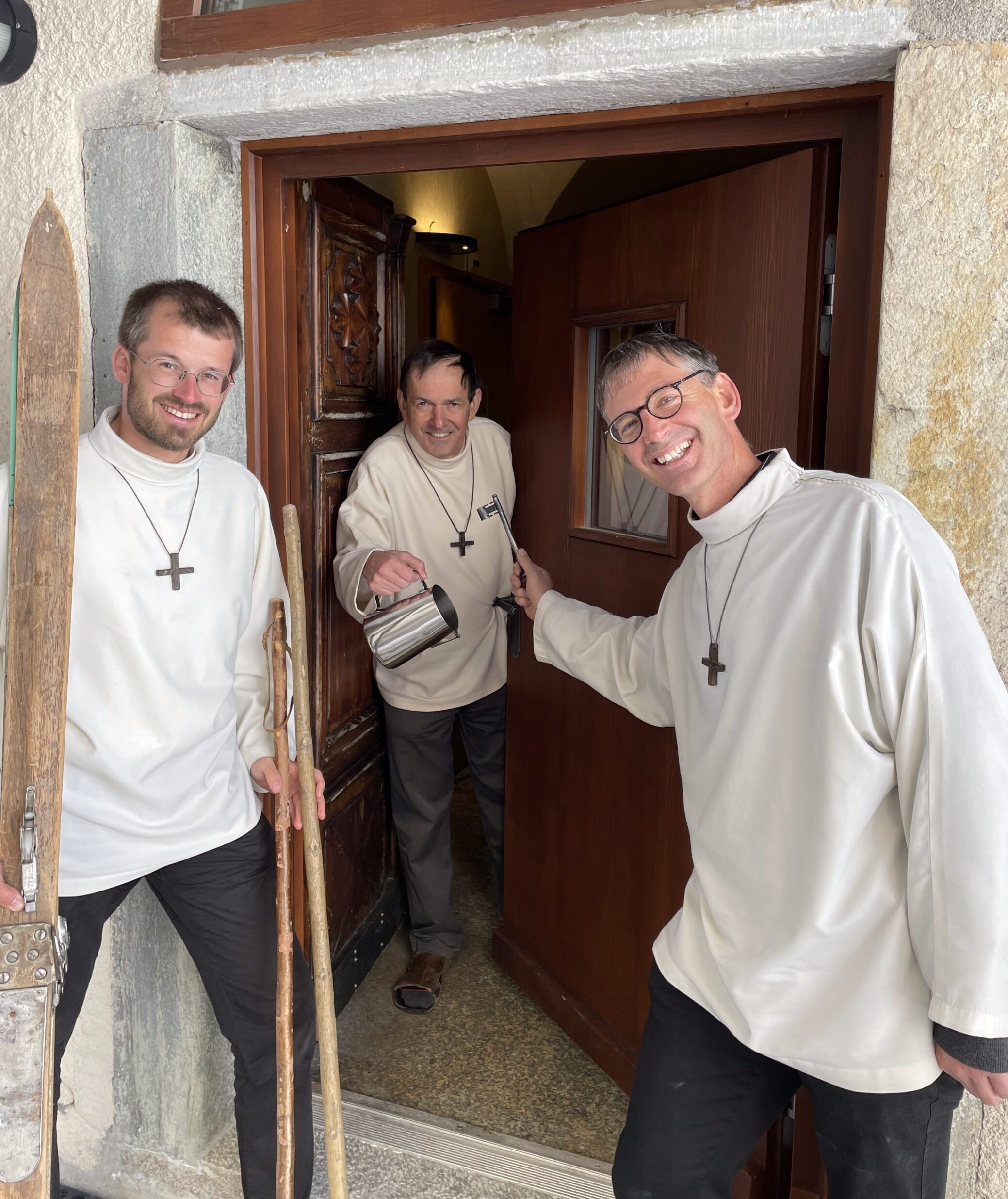
Today, the local community at the Great St Bernard Pass welcomes three new members: Simon Roduit, prior; Joseph Voutaz, monastic bursar and Frédéric Gaillard, who works at reception. Supported by a team of lay helpers, they devote their days to work, prayer and welcoming travellers from all walks of life.

Simon Roduit
Prior of the community
Originally from Saillon, Simon Roduit was born into a family of four children, where he was brought up in the faith; from a very young age, he used to climb up to the Hospice on skin-skis. After serving in the Swiss Guard in Rome, he joined the Congregation of Canons in 2015. Ordained a priest in 2021, he served in the parish as parish priest of Martigny. It was with joy that he responded to the provost’s call to go up to the Great St Bernard Pass, as he is a lover of the mountains. He has become the prior of the local community at the Hospice.

Joseph Voutaz
Monastic bursar
Joseph Voutaz, a former parish priest of Orsières where he served for 10 years, was ordained in 2001 and hails from Sembrancher; he too has already spent several years at the Great St Bernard Hospice. He is now taking up the post of monastic bursar (clavendier).

Frédéric Gaillard
Reception
As for Frédéric Gaillard, a permanent deacon, he is returning to this place where he has already spent twenty-two years. Originally from Orsières, he is resuming his role at reception, where his discretion and kindness are greatly appreciated by all who cross the threshold of the House.
A haven of humanity in the heart of the mountains
Situated at an altitude of 2,473 metres on the Roman road linking Canterbury and Rome,
the Great St Bernard Hospice keeps its doors open to all who pass by.
For nearly 1,000 years, monks have lived there, devoting their lives to welcoming visitors, true to their motto:
‘Here, Christ is worshipped and nourished’.
From the founding of the Hospice to the present day, the community has been able to rely on the generosity of many donors, thanks to whom the mission of hospitality continues.
Promotional video: ‘In the heart of the Alps, a thousand-year-old hospice’
produced by Alpage Productions.
A brief history
Since prehistoric times, the Great St Bernard Pass has been a key route linking the Italian peninsula with the rest of Europe.
A two-thousand-year history
12 BC
The pass has been a crossing point since Prehistory. Under Emperor Augustus (around 12 BC), Rome took possession of it. A Roman road was built, and a temple dedicated to Jupiter gave the place the name it kept for a long time: Mons Jovis (“Mount Jupiter”).
1050
Bernard of Aosta, also known as Bernard of Menthon, archdeacon of the Cathedral of Aosta, saw pilgrims and travellers arriving from the pass in the middle of the 11th century. Many were exhausted, victims of cold and snow; some had been robbed. Since the end of the Roman era, there had no longer been any place of hospitality at the pass, despite the strong flow of travellers. Around 1050, Bernard founded this Hospice for them.
1125
The donation made by Amadeus of Maurienne to the “Church of Saint Nicholas of Mont Joux” in 1125 was the first major offering made to the Hospice. Secular authorities respected this place, believed to be willed by God, and competed in generosity to ensure its survival. Over the centuries, the endowments received by the Hospice provided the resources necessary to fulfil its mission of hospitality.
1752
Maintaining the Hospice was also a matter of power. For centuries, the Canons sought to free themselves from the authority of the House of Savoy, which ruled the Aosta Valley. They achieved full sovereignty in 1752, at the cost of a drastic reduction in their means of subsistence. The small group of Canons who remained on site turned this adversity into the foundation of a new spiritual momentum.
1800
Bonaparte, on his way to the Italian campaign, crossed the pass with 40,000 men and 5,000 horses. The hospitality of the Canons impressed the Emperor. He ordered the creation of a similar house at the Simplon Pass (1801), still run today by the Congregation.
1893
The opening of a road on the Valais side radically changed the nature of hospitality at the pass. Motorised tourists arrived in large numbers. Up to 700 meals were served daily at the Hospice. A “New Hospice” was built opposite the old one. It became a hotel in 1925: as it was no longer possible to feed and accommodate everyone free of charge, visitors arriving by car would stop there rather than at the Hospice.
1964
With the construction of the Great St Bernard Tunnel at the beginning of the 1960s, the Canons questioned the meaning of their presence at the pass. Following the intuition of Canon Gratien Volluz, they envisioned the place that the mountains were called to occupy in our society. Christ, “adored and nourished”, would increasingly be found in the hearts of guests who came to enjoy the mountains, but also to encounter themselves.
